

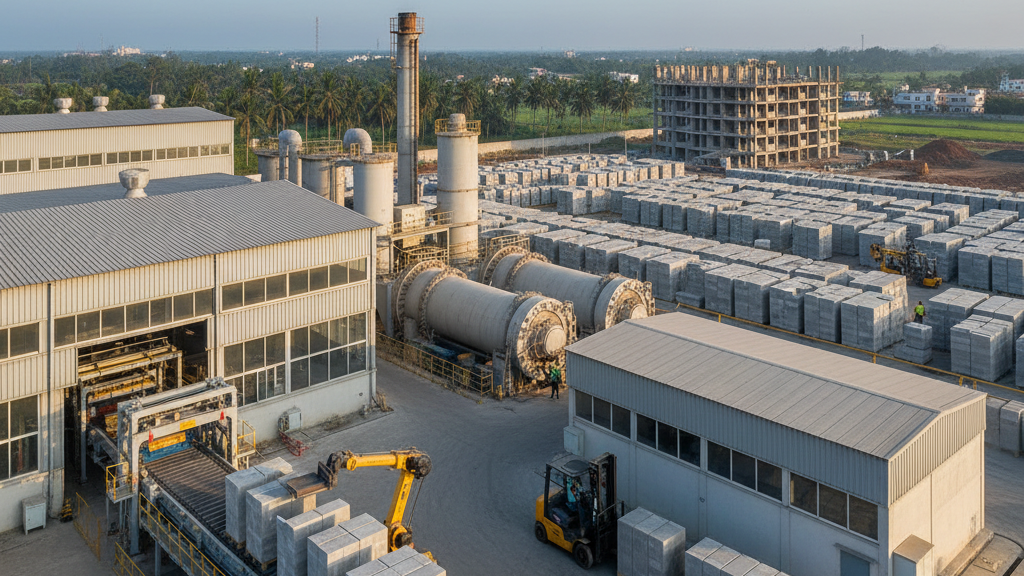
How to Scale FlyAsh Block Manufacturing in India: A Step-by-Step Guide
The demand for lightweight, eco-friendly walling materials like FlyAsh Blocks and AAC Blocks is rising in India’s construction sector. While Featherlite manufactures FlyAsh Blocks, this guide outlines scalable production principles applicable to similar materials—without compromising technical accuracy or market realities.
Understanding the FlyAsh and AAC Block Industry in India
FlyAsh Blocks and AAC Blocks share similarities in raw materials (fly ash, cement, lime) and autoclaving processes. However, scaling production requires addressing:
- Material availability: Fly ash supply depends on thermal plant proximity.
- Energy costs: Autoclaving demands consistent steam and power.
- Market readiness: Builders often prefer conventional bricks due to familiarity.
Key Challenges in Scaling Production
Manufacturers face hurdles when expanding FlyAsh or AAC Block operations:
- Raw material consistency: Fly ash quality varies across regions.
- Logistics: High transportation costs for bulky blocks limit distribution radius.
- Labour training: Thin-bed masonry techniques require skilled applicators.
Strategies for Scaling Manufacturing
To increase output efficiently:
- Modular plant design: Start with a 50,000 m³/year capacity, scaling incrementally.
- Automated batching: Reduce human error in mix proportions (e.g., IS 2185-3 compliance).
- Waste recycling: Reuse cut-off material from block trimming.
Investing in Advanced Manufacturing Technology
Modern AAC/FlyAsh Block plants leverage:
- Vertical cutting machines: Achieve ±1 mm dimensional tolerance (critical for thin-bed joints).
- Energy-efficient autoclaves: Reduce steam consumption by 15–20% with pre-heating systems.
- IoT-enabled monitoring: Track curing times and steam pressure in real time.
Streamlining Raw Material Procurement
Secure reliable sources for:
- Fly ash: Partner with thermal plants under MOUs to ensure Grade-I ash (per IS 3812).
- Aluminium powder: Opt for pre-mixed slurries to minimise dosing variability.
- Cement: Bulk procurement from regional suppliers cuts costs.
Optimising Production Processes
Enhance efficiency through:
- Just-in-time mould filling: Avoid slurry settling in pre-curing stages.
- Multi-shift operations: Autoclaves can run 24/7 with proper maintenance.
- Lean inventory: Store finished blocks near loading bays to minimise handling.
Building a Skilled Workforce
Train staff in:
- Thin-bed adhesive application: Critical for block masonry (per IS 1905).
- QC protocols: Testing compressive strength (3.5–5 N/mm²) and density (550–650 kg/m³).
- Safety: Autoclave handling requires ASME-certified training.
Quality Control at Scale
Implement:
- Batch testing: Daily checks for dimensional stability and dry density.
- Third-party audits: Align with BIS standards for long-term credibility.
- Traceability: Tag batches with production timestamps for defect analysis.
Marketing and Distribution Strategies
Overcome market barriers by:
- Educating builders: Demonstrate cost savings from faster construction and reduced plaster use.
- Regional depots: Establish stockyards within 150 km of high-demand areas.
- Technical support: Offer on-site training for masons transitioning from bricks.
Government Policies and Incentives
Leverage:
- FAME-II subsidies: For energy-efficient autoclaves.
- State-level fly ash utilisation mandates: Reduced GST for eco-friendly materials.
- NBC 2016: Promotes lightweight blocks for seismic zones.
Future Trends in Block Manufacturing
Anticipate:
- Carbon credits: Fly ash utilisation may qualify under clean development mechanisms.
- Pre-fabrication: Demand for pre-insulated block panels in high-rises.
- Alternative binders: Geopolymer-based blocks to reduce cement dependency.
Sustainable Growth in Block Manufacturing
Scaling production requires balancing technology adoption, raw material security, and market education. While FlyAsh Blocks and AAC Blocks differ in formulation, the principles of efficient autoclaving, skilled workforce development, and quality assurance remain universal.