

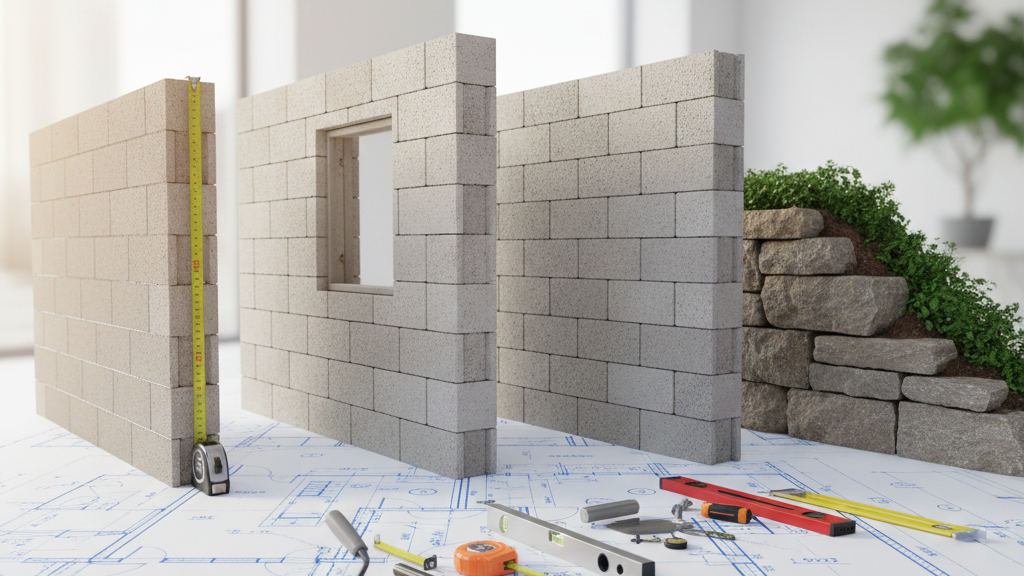
Introduction to Wall Block Thickness
Selecting the right block thickness is a critical decision in wall construction, affecting structural integrity, thermal performance, and compliance with building codes. FlyAsh Blocks, available in thicknesses ranging from 100mm to 250mm, offer versatility for different applications—from internal partitions to load-bearing external walls. This guide examines the factors influencing thickness selection and provides practical recommendations for Indian construction projects.
Factors Influencing Block Thickness Selection
Three primary considerations determine the optimal block thickness:
- Structural requirements: Load-bearing capacity and wall height.
- Thermal and sound insulation: Climate conditions and noise reduction needs.
- Regulatory compliance: Adherence to IS codes and local building bylaws.
Structural Requirements
Load-bearing walls demand thicker blocks (200mm–250mm) to handle vertical loads and lateral forces, while non-load-bearing partitions can use 100mm–150mm FlyAsh Blocks. Refer to IS 1905 for masonry design principles, particularly for multi-storey constructions where wall thickness must correlate with floor loads.
Thermal and Sound Insulation
Thicker blocks (≥150mm) improve thermal resistance—a key factor in India’s tropical climates. For example, a 200mm FlyAsh Block wall can achieve approximately 25–30% better heat insulation than a 100mm wall. Sound insulation follows a similar trend, with 200mm–250mm blocks reducing airborne noise by 40–50 dB, suitable for urban residential projects.
Building Regulations and Standards
Indian standards prescribe minimum thicknesses for specific applications:
- IS 2185-3:2005 recommends ≥150mm for external AAC/FlyAsh Block walls.
- NBC 2016 mandates fire-rated walls ≥200mm for high-rises.
- Local municipal codes may override national standards—always verify region-specific requirements.
Common Block Thickness Options Explained
FlyAsh Blocks are manufactured in standard thicknesses, each suited to distinct use cases:
100mm Blocks – Best for Internal Walls
Ideal for non-load-bearing partitions in homes and offices. Advantages:
- Saves floor space in compact urban dwellings.
- Compatible with thin-bed adhesives for faster installation.
- Meets sound insulation requirements (STC 35–40) for interior walls.
125mm Blocks – Light External Walls
Suitable for single-storey structures or cladding walls where structural loads are minimal. Offers:
- Better weather resistance than 100mm blocks.
- Moderate thermal insulation (U-value ~1.8 W/m²K).
150mm Blocks – Medium-Duty External Walls
The most versatile option for 2–3 storey residential buildings. Benefits include:
- Compliance with IS 2185-3 for external masonry.
- Balanced cost-to-performance ratio.
- Can integrate vertical reinforcement for seismic zones.
200mm Blocks – Heavy-Duty External Walls
Recommended for high-load applications and extreme climates:
- Handles wind loads up to 55 m/s as per NBC wind zone classifications.
- Fire resistance up to 4 hours (with appropriate plaster).
- Superior thermal mass for passive cooling in hot regions.
250mm Blocks – High-Load or Insulated Walls
Used in specialised scenarios:
- Industrial buildings requiring enhanced structural capacity.
- Energy-efficient homes targeting ECBC compliance.
- Acoustic barriers near highways or railways.
How to Determine the Right Thickness for Your Project
A methodical approach ensures optimal selection:
Assessing Load-Bearing Needs
Consult structural drawings to identify:
- Floor-wise load distributions.
- Beam and column support intervals.
- Foundation type (raft, isolated footing, etc.).
Note: A 150mm FlyAsh Block wall can typically support 2–3 storeys with proper mortar joints as per IS 1905.
Climate and Environmental Considerations
Thicker walls (200mm+) are advisable for:
- Hot-dry regions (Rajasthan, Gujarat) to delay heat ingress.
- High-rainfall zones (Kerala, Coastal areas) to prevent moisture penetration.
- Urban sites needing noise attenuation.
Cost vs. Performance Trade-offs
While 250mm blocks offer maximum benefits, they increase:
- Material costs by ~20% compared to 150mm blocks.
- Foundation loads, potentially requiring wider footings.
Balance project budgets with long-term energy savings from thermal efficiency.
Making an Informed Decision
Selecting block thickness requires evaluating technical requirements, environmental factors, and cost implications. FlyAsh Blocks provide adaptable solutions across the 100mm–250mm spectrum, ensuring compliance with Indian standards while optimising performance for diverse construction needs.