

Here is the reviewed and corrected HTML content for your blog:
“`html
How Drones and Robotics Are Revolutionising AAC Masonry Work
The construction industry is evolving rapidly with the integration of drones and robotics. While Featherlite specialises in FlyAsh Blocks, understanding broader advancements in AAC (Autoclaved Aerated Concrete) masonry technology helps builders appreciate competitive developments. This article explores how automation is reshaping precision, speed, and safety in block-based construction.
The Rise of Drones and Robotics in Construction
Modern construction increasingly relies on automation to address labour shortages and quality inconsistencies. Drones and robotics offer measurable improvements in surveying, material handling, and execution—particularly in AAC masonry systems.
Precision Surveying and Site Analysis
Drones equipped with LiDAR or photogrammetry capture high-resolution site data, enabling:
- Real-time topographic mapping for optimal AAC block alignment
- Thermal imaging to identify mortar joint inconsistencies
- Progress tracking against BIM (Building Information Modelling) designs
Automated Material Transport and Placement
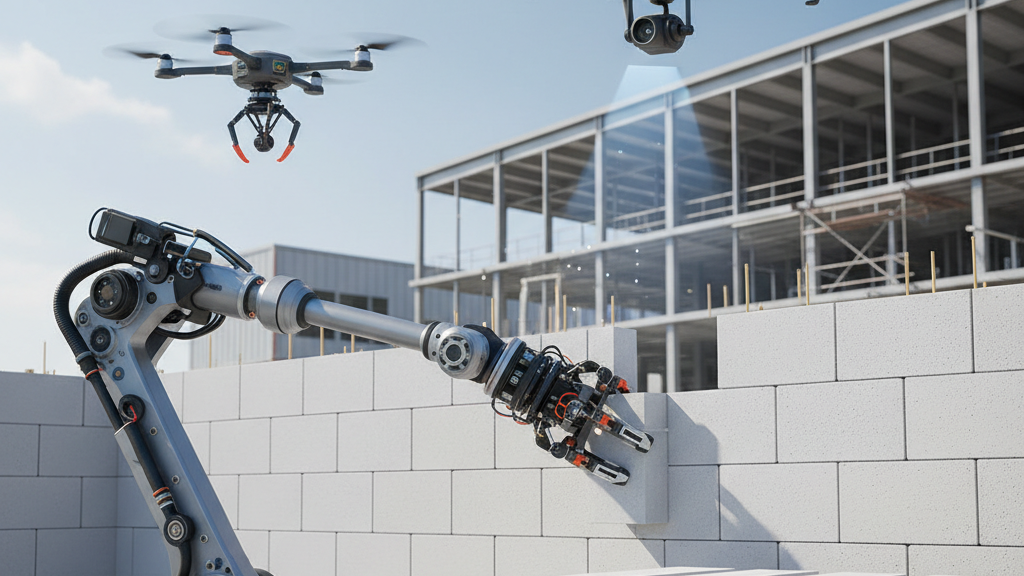
Autonomous drones and robotic arms now handle:
- Precision delivery of AAC blocks to upper floors, reducing manual lifting
- Vertical stacking with millimetre-level accuracy using computer vision
The Role of Robotics in AAC Masonry
Robotic systems are overcoming traditional masonry challenges—particularly in repetitive tasks requiring structural consistency.
Robotic Bricklaying and Assembly
Advanced systems like Hadrian X (for traditional brickwork) demonstrate principles applicable to AAC masonry:
- Automated block cutting and placement at ≈200 blocks/hour
- Adhesive application via programmable nozzles for thin-bed joints
AI-Powered Quality Control and Adjustments
Machine learning algorithms now:
- Analyse drone-captured imagery to flag surface irregularities
- Auto-correct robotic arm trajectories based on AAC block tolerance variations (±1.5mm as per IS 2185-3)
Benefits of Automation in AAC Block Construction
Integrating these technologies offers tangible advantages for Indian projects:
Increased Efficiency and Reduced Labour Costs
Robotic masons work continuously without fatigue, potentially reducing project timelines by 15-30% for large-scale AAC masonry.
Enhanced Safety and Reduced Human Error
Drones minimise rooftop inspections, while robots handle hazardous tasks like high-wall construction with precision.
Challenges and Future Prospects
Despite progress, limitations remain in adopting these technologies for AAC masonry across India.
Current Limitations and Technological Barriers
- High capital costs for robotic systems (₹25-75 lakhs for basic models)
- Limited adaptability to complex architectural designs requiring custom AAC block shapes
The Future of Autonomous AAC Construction
Emerging solutions include:
- Swarm robotics for coordinated multi-block placement
- Self-healing AAC blends compatible with automated curing systems
While Featherlite’s FlyAsh Blocks prioritise manual installation efficiency, monitoring these advancements ensures readiness for future industry shifts. The key lies in balancing innovation with practical on-site applicability in India’s diverse construction landscape.
“`