
“`html
Innovations in Masonry: Exploring 3D Printed Blocks and Hempcrete
Introduction to Modern Masonry Innovations
The construction industry is evolving rapidly with new materials and techniques. Traditional masonry methods — like FlyAsh Blocks (manufactured by Featherlite Buildcon) — remain reliable, but emerging solutions like 3D printed blocks and hempcrete offer exciting alternatives.
These innovations address cost, speed, sustainability, and structural efficiency, while maintaining compatibility with adhesives, plasters, and site practices familiar to Indian builders. Below, we analyse their potential in Indian climates.
3D Printed Masonry Blocks: The Future of Construction
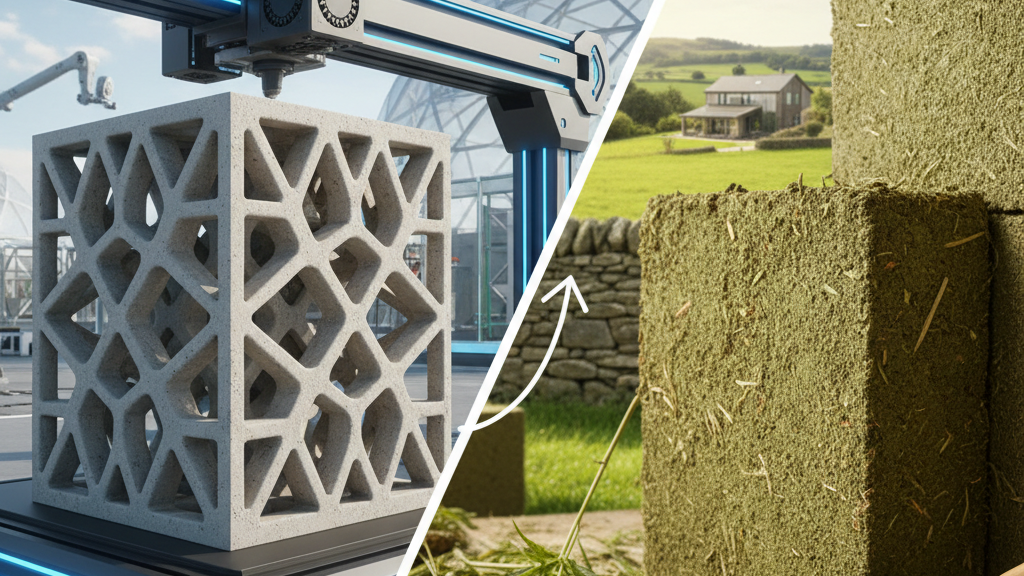
3D printing technology allows precise, layer-by-layer fabrication of blocks with complex geometries. Unlike conventional masonry units, which rely on standard moulds, 3D printed blocks can be customised for:
- Optimised thermal insulation (hollow structures, tailored cavities)
- Reduced material waste (only necessary material is deposited)
- Faster construction (less handling, fewer joints)
How 3D Printing is Revolutionising Masonry
- Design flexibility: Curved walls, interlocking shapes, and embedded conduits.
- Material consistency: No curing variations — every block is identical.
- Reduced labour dependency: Automating block production cuts manpower costs.
Benefits of 3D Printed Blocks
| Feature | Traditional Blocks | 3D Printed Blocks |
|---|---|---|
| Custom shapes | Limited | Highly adaptable |
| Waste generation | 5–10% | <3% |
| Lead time | Days-weeks | Hours-days |
Hempcrete: A Sustainable Masonry Alternative
Hempcrete is a bio-composite made from hemp hurd, lime, and water. Unlike concrete, it is carbon-negative, lightweight, and naturally insulating.
What Makes Hempcrete an Eco-Friendly Choice?
- Low embodied energy (hemp grows rapidly, absorbing CO₂).
- Excellent vapour permeability (reduces condensation risks).
- Non-toxic and fire-resistant (melting point >1,000°C).
However, hempcrete cannot replace load-bearing masonry without reinforcement. Instead, it complements FlyAsh Blocks in partition walls and infill applications.
Comparing Traditional Masonry with Modern Innovations
| Parameter | FlyAsh Blocks | 3D Printed Blocks | Hempcrete |
|---|---|---|---|
| Compressive strength | 3.5–7.5 N/mm² | 5–15 N/mm² | 0.5–2 N/mm² |
| Thermal insulation | Moderate | High | Very High |
| Carbon footprint | Lower than red brick | Medium | Negative |
| Cost (₹/sq.ft for wall) | ₹80–120 | ₹150–250 (projected) | ₹200–350 |
Key takeaway: No single material is perfect — each suits specific use cases.
Case Studies: Successful Applications
- 3D Printed Low-Cost Housing (Chennai) – A pilot project used 3D printed blocks to build a 600 sq.ft home in 10 days.
- Hempcrete School (Pune) – A naturally cooled structure with hempcrete infill walls reduced AC dependency by 40%.
Challenges and Future Prospects
- 3D printing: Requires expensive machinery and skilled operators.
- Hempcrete: Limited availability of hemp hurd in India.
However, as material science advances, these could integrate with FlyAsh Block systems for hybrid solutions.
Conclusion: The Way Forward for Masonry
Innovations like 3D printed blocks and hempcrete expand options but don’t replace proven materials. FlyAsh Blocks remain a cost-efficient, high-strength choice for Indian builders. The future lies in combining traditional wisdom with new techniques for sustainable, efficient construction.
Ready to explore the right masonry system for your project? Each method has trade-offs — understanding them leads to smarter builds.
“`