

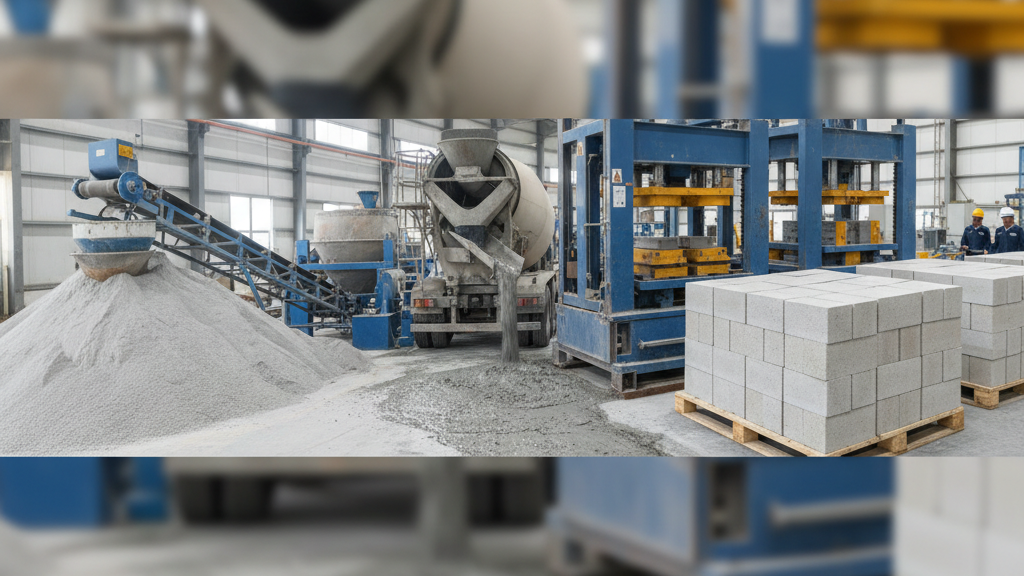
Introduction to Fly Ash Blocks
FlyAsh Blocks are a sustainable alternative to traditional clay bricks and concrete blocks in Indian construction. Made primarily from fly ash—a byproduct of coal-fired power plants—these blocks offer superior thermal insulation, lighter weight, and better dimensional accuracy than conventional masonry units. Their manufacturing process aligns with India’s push for eco-friendly building materials under the National Action Plan on Climate Change.
The Fly Ash Block Manufacturing Process
Producing FlyAsh Blocks involves six critical stages, each ensuring structural integrity and consistency. The process adheres to IS 2185-3 (2008) for autoclaved aerated concrete (AAC) units, though FlyAsh Blocks differ in composition and curing methods.
Step 1: Raw Material Collection and Preparation
Key raw materials include:
- Fly ash (60–65% by volume): Sourced from thermal power plants, sieved to remove impurities.
- Cement (10–15%): Acts as a binder, typically OPC 43-grade.
- Sand/Aluminium powder (optional): For density control in some formulations.
- Water: Treated to minimise dissolved salts.
Materials are stored in silos to prevent moisture absorption. Fly ash quality is verified for unburnt carbon content (<5% as per IS 3812).
Step 2: Mixing Fly Ash with Other Components
A batch mixer combines materials in precise ratios:
- Dry mix fly ash, cement, and sand for 2–3 minutes.
- Add water gradually to achieve a slump of 180–200 mm.
- For aerated variants, aluminium paste is introduced (0.05–0.08% by weight).
Note: Over-mixing can cause premature setting; under-mixing leads to weak blocks.
Step 3: Moulding the Blocks
The slurry is poured into steel moulds coated with release agents. Two moulding techniques are common:
- Vibro-compaction: Uses vibration to eliminate air pockets (for denser blocks).
- Static casting: For lighter, cellular blocks.
Moulds are sized to account for 1–2% shrinkage during curing.
Step 4: Curing the Blocks
Curing occurs in two phases:
- Initial setting (24 hours): Blocks remain in moulds at ambient temperature (25–30°C).
- Steam curing (12–18 hours): Blocks are transferred to autoclaves at 180–200°C under 10–12 bar pressure, accelerating strength gain.
This process achieves 80% of compressive strength within 72 hours (IS 6441 testing standards).
Step 5: Quality Control and Testing
Every batch undergoes:
- Compressive strength: Minimum 3.5 N/mm² (as per IS 2185-3).
- Density: 600–800 kg/m³ for standard blocks.
- Dimensional checks: Tolerance of ±2 mm on length/height.
- Water absorption: <10% after 24-hour immersion.
Rejected blocks are crushed and recycled into new batches.
Step 6: Packaging and Distribution
Finished blocks are:
- Stacked on wooden pallets to prevent edge damage.
- Shrink-wrapped for moisture protection during transit.
- Labelled with manufacturing date, batch number, and strength grade.
Transport vehicles must have flat beds with anti-slip mats to minimise breakage.
Benefits of Using Fly Ash Blocks
Compared to red bricks or conventional concrete blocks, FlyAsh Blocks offer:
- Thermal insulation: U-values of 0.24–0.35 W/mK, reducing HVAC loads.
- Faster construction: Larger block sizes (600×200×250 mm typical) with thin-bed joints.
- Seismic resistance: Lower dead load improves performance in high-wind/earthquake zones (NBC 2016).
- Fire rating: 2–4 hours depending on thickness.
Environmental Impact and Sustainability
FlyAsh Blocks contribute to:
- Waste reduction: Utilises 1.2–1.5 tonnes of fly ash per 10 m³ of blocks.
- Lower CO₂ emissions: 75% less embodied carbon than fired bricks.
- Water conservation: 50% less water used vs. traditional brick production.
They qualify for IGBC and GRIHA green building credits.
Conclusion: The Future of Fly Ash Block Manufacturing
With India’s fly ash production exceeding 250 million tonnes annually (CPCB 2023), FlyAsh Blocks present a scalable solution for sustainable construction. Advances in nano-silica additives and automated curing systems are further enhancing their strength and consistency, positioning them as a mainstream walling material for India’s urban and rural infrastructure.