

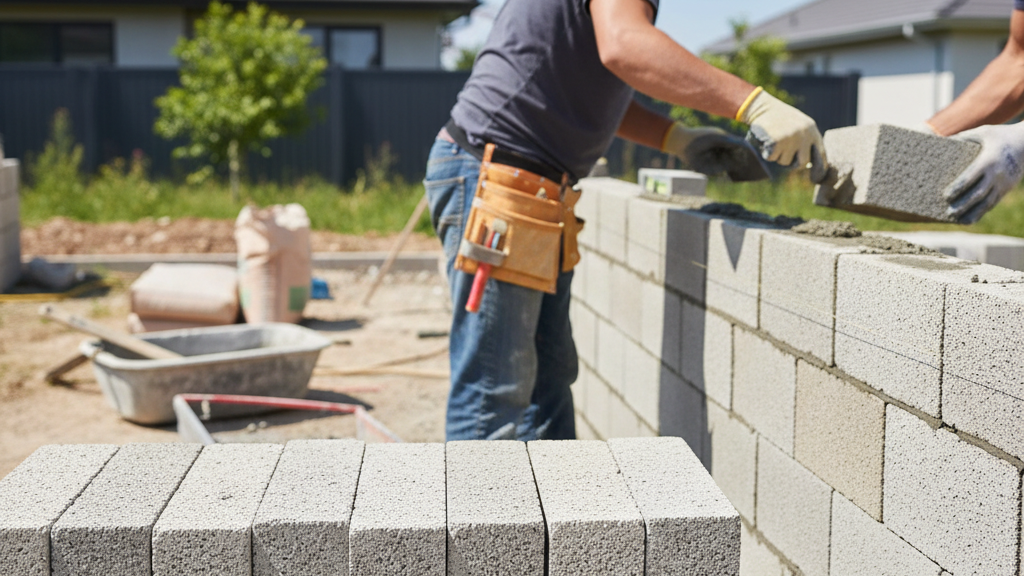
Introduction to Fly-Ash Blocks
Fly-ash blocks are lightweight, high-strength masonry units made from fly ash—a byproduct of coal combustion—along with cement, lime, and water. These blocks offer a sustainable alternative to traditional red bricks, with consistent dimensions that enable faster construction. In India, their use aligns with eco-friendly building practices while meeting structural requirements under IS 2185 Part 3 (for similar lightweight blocks).
Benefits of Using Fly-Ash Blocks
- Thermal insulation: Reduces heat transfer by 20–30% compared to conventional bricks, lowering cooling loads.
- Lightweight: Weighs ~30% less than clay bricks, decreasing structural load.
- Workability: Uniform size allows thin-bed adhesive joints (2–3 mm) for precise alignment.
- Fire resistance: Non-combustible with a 2–4 hour fire rating depending on thickness.
- Sound attenuation: Achieves STC 45–50 for 200 mm thick walls.
Materials and Tools Required
- Materials: Fly-ash blocks, thin-bed adhesive (or cement-sand mortar), water, DPC membrane.
- Tools: Trowel, spirit level, masonry saw, rubber mallet, measuring tape, string line, mortar mixer.
Note: For load-bearing walls, use adhesive/mortar with minimum 5 MPa compressive strength as per IS 1905.
Step 1: Preparing the Foundation
- Excavate trench to firm soil (minimum 600 mm depth for single-storey walls).
- Pour plain cement concrete (PCC) layer (1:4:8 mix) and level.
- Lay damp-proof course (DPC) membrane over cured PCC.
Step 2: Mixing the Mortar
- For thin-bed adhesive: Mix powder with water to peanut-butter consistency (0.25–0.3 water/powder ratio).
- For cement-sand mortar: Use 1:4 ratio with plasticiser (allow 10 mm joint thickness).
- Mix in small batches (30-minute working time for adhesives).
Step 3: Laying the First Course
- Dry-lay blocks along the foundation to plan bond pattern.
- Apply mortar/adhesive bed (3–5 mm thick) over DPC.
- Place corner blocks first, checking level and alignment with string lines.
- Fill gaps with cut blocks using masonry saw.
Step 4: Building Subsequent Layers
- Stagger vertical joints by ≥40% of block length (standard running bond).
- Apply adhesive to vertical joints using notch trowel before placing each block.
- Tap blocks gently with rubber mallet to seat properly.
- Maintain 600 mm maximum unsupported height per work session.
Step 5: Checking for Level and Plumb
- Verify horizontal alignment every 3 courses with spirit level.
- Check plumb (verticality) using plumb bob or laser level.
- Adjust blocks within 15 minutes of placement.
Step 6: Finishing Touches
- Install lintels over openings (pre-cast RCC or angle iron).
- Fill perimeter gaps with polyurethane foam or mortar.
- Apply scratch coat if direct plastering is planned.
Common Mistakes to Avoid
- Improper curing: Keep mortar joints moist for 48 hours in hot weather.
- Thick joints: Exceeding 5 mm reduces strength advantage of precision blocks.
- Missing DPC: Causes capillary water rise in walls.
- Rushing courses: Allow 24 hours before loading (adhesive) or 7 days (mortar).
Maintenance Tips for Fly-Ash Block Walls
- Inspect mortar joints annually for cracks (repair with polymer-modified mortar).
- Use vapour-permeable paints to prevent moisture trapping.
- For external walls, apply hydrophobic sealant every 5 years in high-rainfall zones.
Conclusion
Fly-ash block construction combines speed, sustainability, and structural efficiency when executed with proper techniques. The thin-bed method maximises material benefits while minimising thermal bridges. For Indian projects, this system reduces both construction timelines and long-term energy costs—provided basic quality controls are maintained throughout the process.