

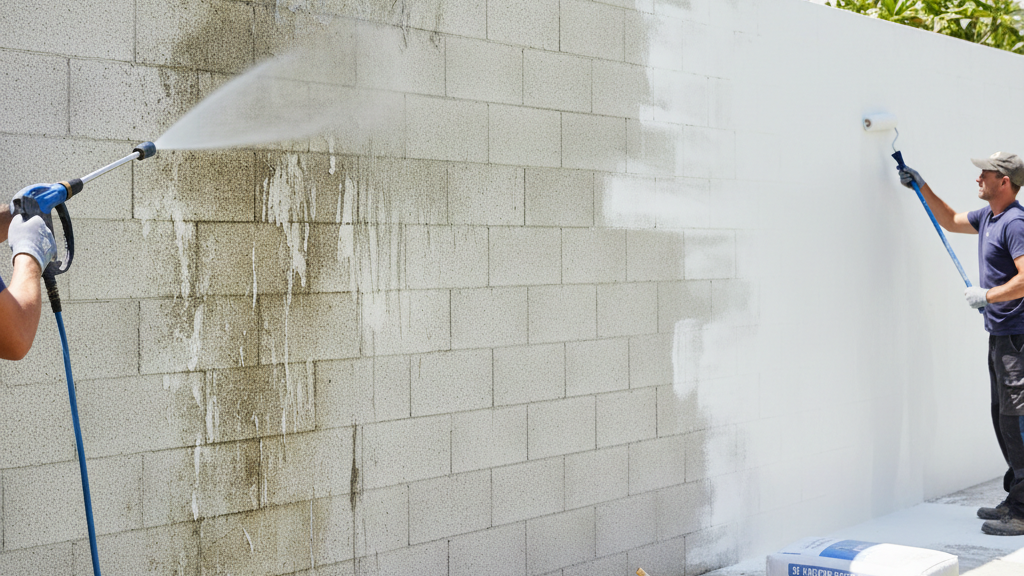
Understanding AAC Walls and Their Unique Requirements
Autoclaved aerated concrete (AAC) walls offer lightweight, thermal-efficient masonry, but their porous structure demands specialised cleaning and finishing approaches. Unlike traditional brickwork, AAC’s high absorption rate requires surface treatments that balance breathability with weather resistance. Proper preparation ensures finishes adhere without compromising the material’s vapour permeability—a critical factor in India’s humid climates.
Preparing AAC Walls for Cleaning and Finishing
Before applying any finish, AAC surfaces must be:
- Free of dust and debris: Use stiff bristle brushes or low-pressure air blowers.
- Stabilised against moisture: Apply a penetrating primer for high-absorption areas.
- Repaired: Fill minor cracks with AAC-compatible patching compounds.
Avoid high-pressure washing, which can erode the surface. For stubborn stains, pH-neutral cleaners prevent material degradation.
Effective Cleaning Techniques for AAC Surfaces
Three proven methods for AAC wall cleaning:
- Dry cleaning: Remove loose particles with non-metallic scrapers.
- Damp wiping: Use microfiber cloths with mild detergent (max 5% concentration).
- Spot treatment: For efflorescence, apply diluted white vinegar (1:3 ratio with water).
Always test cleaners on inconspicuous areas first. Rinse thoroughly within 15 minutes of application.
Choosing the Right Exterior Finishes for AAC
Opt for vapour-permeable systems that align with AAC’s performance:
- Mineral-based renders: Cement-free lime or silicate finishes (3–5 mm thickness).
- Elastomeric coatings: Acrylic formulations with >150% elongation for crack-bridging.
- Textured paints: Siloxane-modified products with water repellency (per IS 15489).
Avoid cement-rich plasters or non-breathable films that trap moisture.
Step-by-Step Guide to Applying Exterior Finishes
- Prime: Apply alkali-resistant primer using roller/brush (coverage: 4–6 sqm/litre).
- Base coat: Trowel on reinforcing mesh with 2 mm notch (cure 48 hours).
- Finish coat: Apply final layer with stainless steel float (ambient temp: 5–35°C).
- Curing: Mist-spray water twice daily for 3 days in dry weather.
Work in shaded conditions—direct sunlight accelerates drying, causing shrinkage cracks.
Common Mistakes to Avoid When Finishing AAC Walls
- Oversaturation: Wetting surfaces beyond 15% moisture content before coating.
- Incompatible materials: Mixing cement-based products with AAC without interface layers.
- Poor timing: Applying finishes during monsoon or extreme heat (>40°C).
- Thick applications: Exceeding manufacturer’s recommended thickness (typically ≤5 mm).
Maintenance Tips for Long-Lasting AAC Wall Finishes
Extend finish lifespan with:
- Annual inspections: Check for hairline cracks post-monsoon.
- Localised repairs: Patch damaged areas with matching compounds.
- Gentle cleaning: Bi-annual soft washing (max 30 psi pressure).
Reapply protective coatings every 5–7 years in coastal regions (as per IS 12642).
FAQs About AAC Wall Cleaning and Finishing
Q: Can tile cladding be applied directly to AAC walls?
A: Not recommended—use a decoupling membrane (2 mm min) to accommodate differential movement.
Q: How to identify non-breathable finishes?
A: Perform a water droplet test—beads that remain on the surface for >1 hour indicate low permeability.
Q: Is sandblasting suitable for AAC cleaning?
A: Never—abrasive methods damage the cellular structure. Use chemical poultices for graffiti removal.
Understanding AAC Walls and Their Unique Requirements
Autoclaved aerated concrete (AAC) walls offer lightweight, thermal-efficient masonry, but their porous structure demands specialised cleaning and finishing approaches. Unlike traditional brickwork, AAC’s high absorption rate requires surface treatments that balance breathability with weather resistance. Proper preparation ensures finishes adhere without compromising the material’s vapour permeability—a critical factor in India’s humid climates.
Preparing AAC Walls for Cleaning and Finishing
Before applying any finish, AAC surfaces must be:
- Free of dust and debris: Use stiff bristle brushes or low-pressure air blowers.
- Stabilised against moisture: Apply a penetrating primer for high-absorption areas.
- Repaired: Fill minor cracks with AAC-compatible patching compounds.
Avoid high-pressure washing, which can erode the surface. For stubborn stains, pH-neutral cleaners prevent material degradation.
Effective Cleaning Techniques for AAC Surfaces
Three proven methods for AAC wall cleaning:
- Dry cleaning: Remove loose particles with non-metallic scrapers.
- Damp wiping: Use microfiber cloths with mild detergent (max 5% concentration).
- Spot treatment: For efflorescence, apply diluted white vinegar (1:3 ratio with water).
Always test cleaners on inconspicuous areas first. Rinse thoroughly within 15 minutes of application.
Choosing the Right Exterior Finishes for AAC
Opt for vapour-permeable systems that align with AAC’s performance:
- Mineral-based renders: Cement-free lime or silicate finishes (3–5 mm thickness).
- Elastomeric coatings: Acrylic formulations with >150% elongation for crack-bridging.
- Textured paints: Siloxane-modified products with water repellency (per IS 15489).
Avoid cement-rich plasters or non-breathable films that trap moisture.
Step-by-Step Guide to Applying Exterior Finishes
- Prime: Apply alkali-resistant primer using roller/brush (coverage: 4–6 sqm/litre).
- Base coat: Trowel on reinforcing mesh with 2 mm notch (cure 48 hours).
- Finish coat: Apply final layer with stainless steel float (ambient temp: 5–35°C).
- Curing: Mist-spray water twice daily for 3 days in dry weather.
Work in shaded conditions—direct sunlight accelerates drying, causing shrinkage cracks.
Common Mistakes to Avoid When Finishing AAC Walls
- Oversaturation: Wetting surfaces beyond 15% moisture content before coating.
- Incompatible materials: Mixing cement-based products with AAC without interface layers.
- Poor timing: Applying finishes during monsoon or extreme heat (>40°C).
- Thick applications: Exceeding manufacturer’s recommended thickness (typically ≤5 mm).
Maintenance Tips for Long-Lasting AAC Wall Finishes
Extend finish lifespan with:
- Annual inspections: Check for hairline cracks post-monsoon.
- Localised repairs: Patch damaged areas with matching compounds.
- Gentle cleaning: Bi-annual soft washing (max 30 psi pressure).
Reapply protective coatings every 5–7 years in coastal regions (as per IS 12642).
FAQs About AAC Wall Cleaning and Finishing
Q: Can tile cladding be applied directly to AAC walls?
A: Not recommended—use a decoupling membrane (2 mm min) to accommodate differential movement.
Q: How to identify non-breathable finishes?
A: Perform a water droplet test—beads that remain on the surface for >1 hour indicate low permeability.
Q: Is sandblasting suitable for AAC cleaning?
A: Never—abrasive methods damage the cellular structure. Use chemical poultices for graffiti removal.