

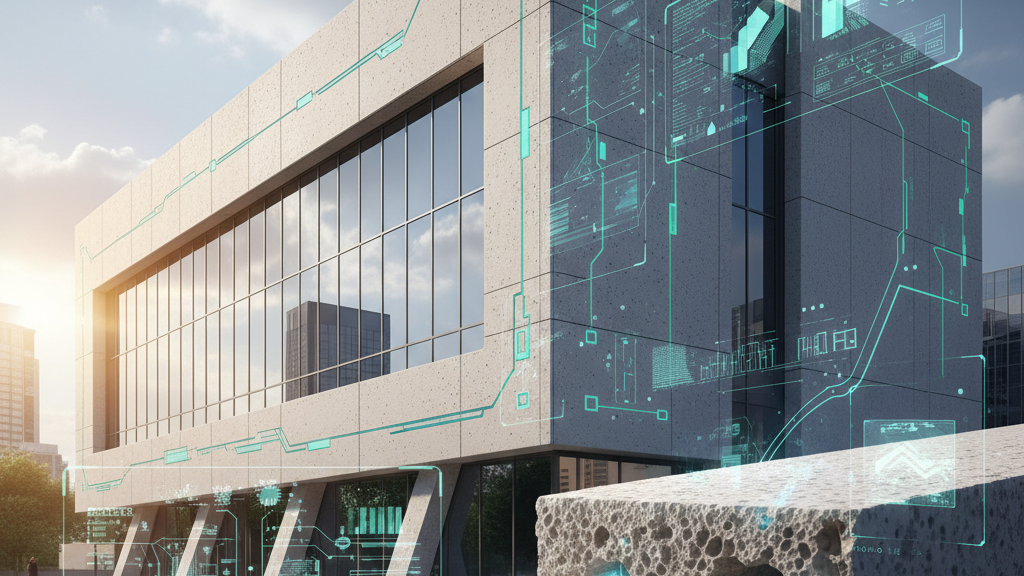
Introduction to Smart Buildings and Advanced Materials
Smart buildings integrate technology with construction to optimise energy use, safety, and operational efficiency. Advanced materials like autoclaved aerated concrete (AAC) are pivotal in delivering these objectives. Unlike conventional masonry, AAC aligns with modern demands for sustainability and structural performance while enabling seamless integration with smart systems.
What is Autoclaved Aerated Concrete (AAC)?
AAC is a lightweight, precast material composed of fly ash or sand, cement, lime, and aluminium powder. Cured under heat and pressure, it forms a cellular structure offering high strength-to-weight ratios. AAC is often confused with non-autoclaved fly ash blocks (like those manufactured by Featherlite Buildcon), but differs in production methods and density ranges.
Benefits of AAC in Smart Building Construction
AAC supports smart building goals through:
- Modularity: Precise dimensions facilitate faster construction, reducing on-site waste.
- Compatibility: Easy integration with wiring conduits and IoT sensors.
- Adaptability: Suitable for seismic zones due to low mass and flexibility.
Energy Efficiency and Sustainability
AAC’s thermal mass reduces cooling loads by up to 30% compared to traditional bricks, per studies under Indian climatic conditions. Its production uses recycled fly ash (per IS 2185-3), lowering embodied carbon. However, energy-intensive autoclaving remains a trade-off.
Lightweight Yet Durable Properties
With densities between 400–800 kg/m³, AAC achieves compressive strengths of 3–5 N/mm² (IS 2185-3), sufficient for low-rise to mid-rise structures.
This reduces foundation costs and simplifies handling, critical in high-rise urban projects.
Fire Resistance and Safety
AAC provides 2–6 hours of fire resistance (depending on thickness), complying with NBC 2016. Its inorganic composition prevents toxic smoke emission—a key consideration for smart buildings with dense electrical installations.
Thermal Insulation Capabilities
AAC’s R-value ranges between 0.8–1.25 per inch, outperforming red bricks (0.2–0.3). This reduces HVAC dependency, aligning with smart buildings’ energy-monitoring systems.
How AAC Complements Smart Building Technologies
Smooth AAC surfaces simplify sensor mounting, while its sound attenuation (45 dB for 200mm walls) supports acoustically sensitive automation systems. Cavities within AAC blocks also allow discreet routing for wiring.
Case Studies: Successful AAC Implementations
Notable Indian projects:
- IT Parks in Bengaluru: AAC’s thermal efficiency reduced cooling costs by 22% post-retrofit.
- Delhi Metro Stations: Fire-resistant AAC partitions enhanced safety compliance.
Future Trends: AAC and Smart Construction
Emerging developments include:
- Self-sensing AAC: Embedding strain sensors for real-time structural health monitoring.
- 3D-printed AAC elements: Custom shapes for complex architectural designs.
Conclusion: Why AAC is a Game-Changer
AAC bridges traditional masonry and smart construction needs. While alternatives like fly ash blocks (e.g., Featherlite’s non-autoclaved products) serve cost-sensitive projects, AAC excels where thermal, fire, and automation integration are prioritised. Its role will expand as smart buildings evolve.