

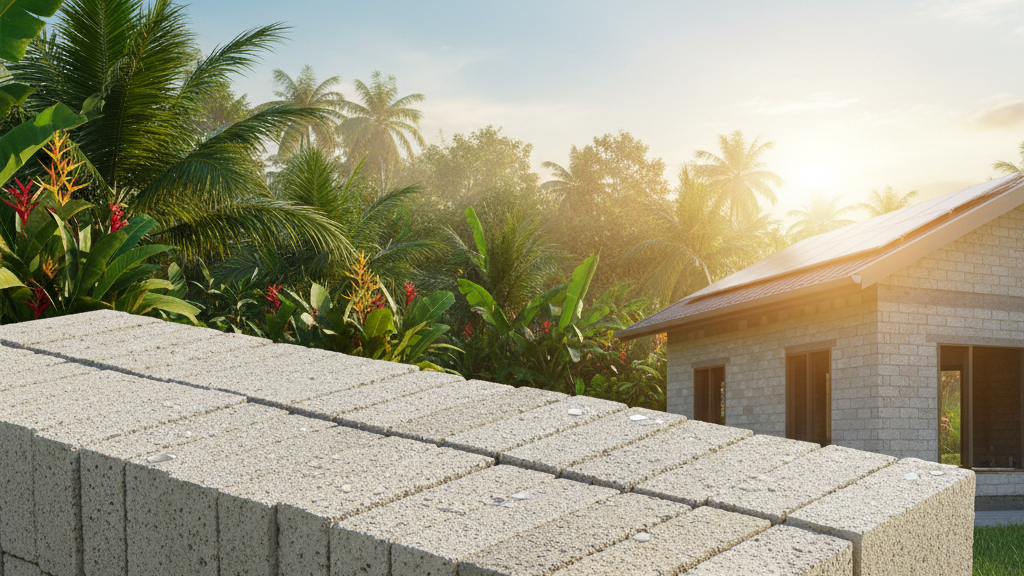
Benefits of FlyAsh Blocks in Hot & Humid Climates: A Sustainable Solution
Introduction to FlyAsh Blocks
FlyAsh Blocks are precast masonry units utilising fly ash—a coal combustion by-product—as a key component. When paired with thin-bed adhesives and compatible plasters, they form durable, lightweight walling systems. Particularly in India’s tropical regions, their thermal and moisture-resistant properties offer distinct advantages over conventional materials.
Why FlyAsh Blocks Are Ideal for Hot & Humid Climates
Hot, humid climates demand materials that combat heat ingress, resist mould growth, and maintain structural integrity despite moisture exposure. FlyAsh Blocks address these challenges through:
- Low thermal conductivity, reducing heat transfer into interiors
- Capillary pore structures that limit water absorption
- Alkaline composition inhibiting organic growth
Thermal Performance
FlyAsh Blocks’ cellular structure creates air pockets that act as insulators. Comparative studies against dense clay bricks show:
- Indoor temperature reductions of 3–5°C in non-AC spaces
- Lower thermal conductivity values (typically 0.15–0.30 W/mK range)
IS 2185-3 (AAC blocks) recognises the thermal advantages of lightweight blocks—similar principles apply to FlyAsh Blocks.
Moisture Resistance
High humidity accelerates degradation in traditional masonry. FlyAsh Blocks exhibit:
- Water absorption rates under 15% (as per IS 2185-3), reducing efflorescence risks
- Minimal dimensional changes during wet-dry cycles
Sustainability and Environmental Benefits
FlyAsh Blocks repurpose industrial waste (fly ash constitutes 60–70% of their volume). Their production:
- Consumes 40% less energy than fired clay bricks
- Avoids topsoil depletion from clay extraction
- Generates 30–50% lower CO₂ emissions per cubic metre
Comparing FlyAsh Blocks to Traditional Materials
Against red clay bricks (IS 1077):
- Weight: ~30% lighter, reducing foundation loads
- Thermal lag: 8–10 hours vs. 4–6 hours for dense bricks
- Mortar consumption: 4x less with thin-bed adhesives
Durability and Longevity
Properly installed FlyAsh Block walls demonstrate:
- Compressive strengths of 3–5 MPa (adequate for low-rise buildings per IS 1905)
- No corrosion of embedded elements due to high pH (~11)
- Service lives exceeding 50 years in coastal/humid zones
Challenges and Considerations
Practical limitations include:
- Requiring skilled masons for thin-bed adhesive application
- Lower impact resistance than dense concrete blocks
- Needing vapour-permeable finishes to prevent condensation traps
Maintenance Tips for FlyAsh Blocks
Maximise longevity with:
- Annual inspections for hairline cracks (seal with acrylic fillers)
- Avoiding cement-based paints—use silicate or mineral coatings
- Ensuring roof drainage directs water away from walls
Conclusion: The Future of FlyAsh Blocks in Tropical Regions
As Indian construction prioritises sustainability and climate resilience, FlyAsh Blocks—with their validated thermal, moisture-resistant, and eco-efficient properties—emerge as a pragmatic choice. Advances in thin-bed adhesives and breathable plasters further enhance their suitability for hot, humid zones.