

Autoclave Curing: How It Works and Why It Matters in Construction Materials
In the production of high-performance masonry units like FlyAsh Blocks, curing methods determine strength, dimensional stability, and long-term durability. Autoclave curing stands apart from conventional techniques by combining high-pressure steam with precise temperature control. This industrial process is integral to manufacturing standard-compliant walling materials, particularly where structural reliability matters.
How Autoclave Curing Works
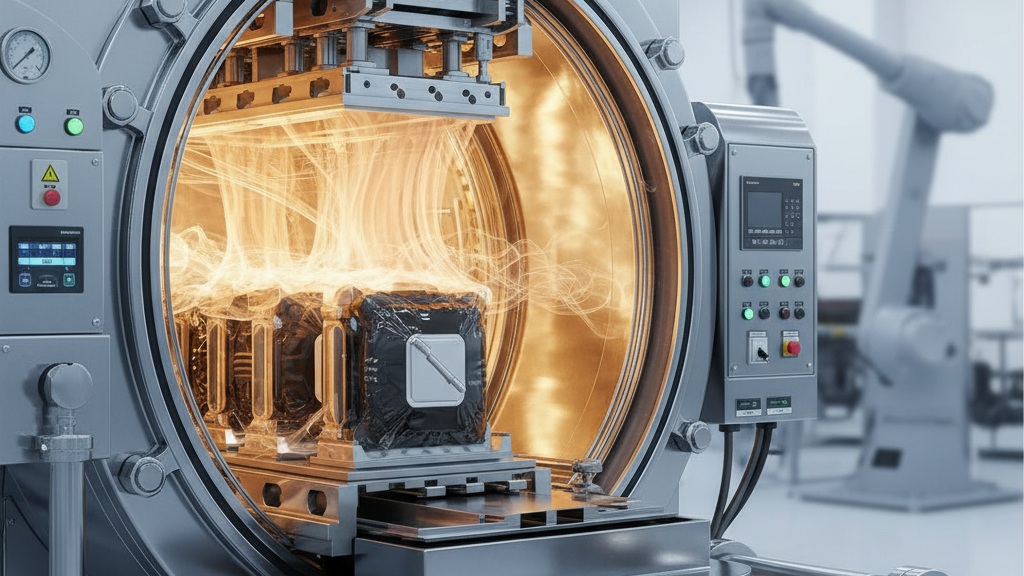
Autoclave curing is a closed-system steam treatment conducted in pressurised chambers. Unlike traditional air-drying or oven curing, it accelerates chemical reactions within materials through controlled conditions:
- Pre-Curing Phase: Freshly moulded blocks (e.g., FlyAsh Blocks) initialise partial setting through ambient drying or low-heat treatment.
- Loading: Units are stacked in curing trolleys designed for even steam penetration.
- Pressurised Steam Treatment: Chambers reach 8–12 bars at 180–200°C, typically for 8–12 hours, triggering pozzolanic reactions in fly ash.
- Gradual Depressurisation: Prevents thermal shock, ensuring crack-free outputs.
Autoclaving transforms amorphous silica in fly ash into crystalline tobermorite, enhancing compressive strength (as per IS 2185-3 for non-load-bearing blocks).
Benefits of Autoclave Curing
For construction materials, autoclave curing offers measurable advantages over ambient or oven drying:
- Higher Strength: Achieves 3.5–7 N/mm² compressive strength in 24 hours versus weeks for air-cured alternatives.
- Dimensional Precision: Limits shrinkage to under 0.04%, critical for thin-bed adhesive compatibility.
- Consistency: Uniform curing eliminates weak spots common in sun-dried bricks.
- Eco-Efficiency: Steam curing recycles heat energy and fully utilises fly ash—a thermal power plant byproduct.
Practical Applications in Construction
Autoclaved materials like FlyAsh Blocks are preferred in:
- High-Rise Masonry: Where lightweight and load distribution are critical.
- Thermal Insulation Walls: Enhanced thermal resistivity (0.15–0.30 W/mK) from aerated structures.
- Fast-Track Projects: Immediate post-curing usability reduces site delays.
Autoclave vs. Oven Curing: A Technical Comparison
| Parameter | Autoclave Curing | Oven Curing |
|---|---|---|
| Pressure | 8–12 bars (steam-pressurised) | Atmospheric pressure |
| Energy Input | Steam recycling lowers kWh/tonne | Direct resistive heating |
| Curing Time | 8–12 hours | 24–72 hours |
| Material Suitability | Fly ash, lime-based mixes | Polymers, ceramics |
Addressing Common Queries
Can red bricks be autoclaved?
No—traditional clay bricks vitrify in kilns, whereas autoclaving requires reactive silica sources like fly ash.
Does autoclaving eliminate efflorescence risks?
It reduces soluble salts but proper adhesive selection (e.g., polymer-modified thin-bed mortars) remains essential.