
Introduction to AAC and Fly Ash Blocks
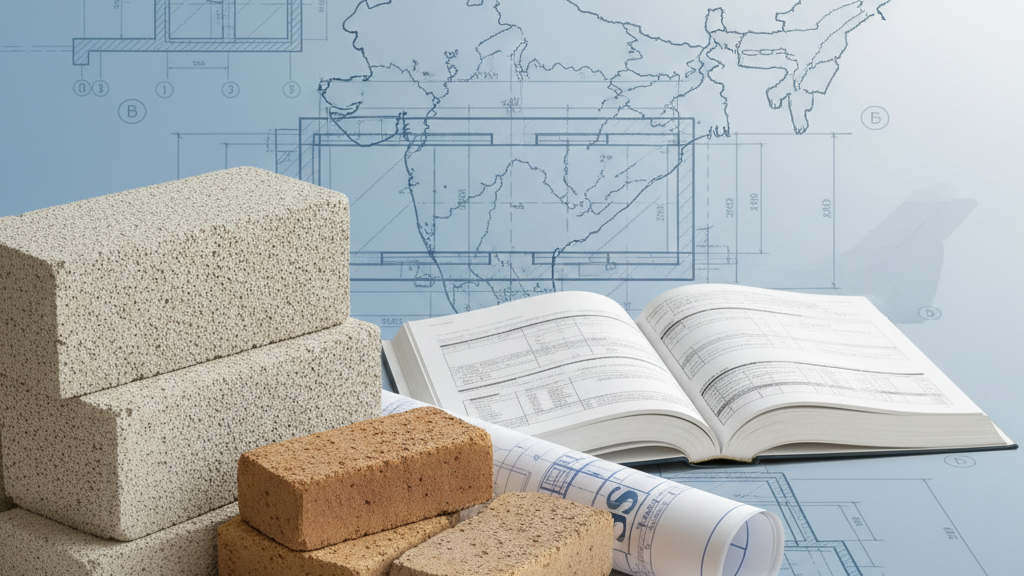
AAC (autoclaved aerated concrete) blocks and FlyAsh blocks are widely used in modern Indian construction for their lightweight, thermal insulation, and sustainability benefits. While AAC blocks use aluminium-based aeration, FlyAsh blocks utilise thermal power plant by-products, reducing environmental impact. Compliance with Indian Standard (IS) codes ensures structural safety, durability, and performance.
Understanding IS Codes for Construction Materials
IS codes are technical guidelines published by the Bureau of Indian Standards (BIS) to standardise construction materials and methods. They define:
- Material composition and strength parameters
- Testing procedures for quality assurance
- Dimensional tolerances and installation protocols
Adherence to IS codes is often mandated by Indian building regulations (NBC 2016) for load-bearing and partition walls.
Key IS Codes Applicable to AAC Blocks
AAC blocks must conform to two primary standards:
IS 2185 (Part 3): Specification for Autoclaved Cellular Concrete Blocks
This code defines:
- Minimum compressive strength (3–5 N/mm² for load-bearing walls)
- Dry density ranges (451–750 kg/m³ for Grade I)
- Dimensional tolerances (±3 mm for length/width)
- Moisture content limits (≤15% by mass)
IS 6441: Testing Methods for AAC Blocks
Covers procedures for:
- Compressive strength (cube test)
- Density measurement (water displacement method)
- Thermal conductivity (guarded hot plate method)
Key IS Codes Applicable to FlyAsh Blocks
FlyAsh blocks are governed by:
IS 12894: Specification for Fly Ash Bricks
Mandates:
- Minimum compressive strength (7.5 N/mm² for Class A)
- Water absorption limits (≤20% by mass)
- Dimensional stability (warpage ≤5 mm/m)
IS 3812: Specification for Pulverised Fuel Ash
Classifies fly ash into:
- Grade I (SiO2+Al2O3+Fe2O3 ≥ 70%)
- Grade II (50–70% combined oxides)
Defines lime reactivity and fineness requirements.
Importance of Compliance with IS Codes
Non-compliant blocks risk:
- Structural failures due to under-strength materials
- Cracking from high moisture absorption
- Thermal/acoustic performance gaps
Projects requiring municipal approval (e.g., high-rises) often mandate BIS-certified materials.
How to Verify IS Code Certification
To authenticate compliance:
- Check for the BIS mark (Standard Mark Scheme license number)
- Review test certificates from NABL-accredited laboratories
- Request batch-wise quality assurance reports from manufacturers
Featherlite FlyAsh Blocks comply with IS 12894, with test data available on request.
Frequently Asked Questions
Can AAC and FlyAsh blocks be used interchangeably?
No. AAC blocks (IS 2185) have lower density and strength than FlyAsh blocks (IS 12894). Usage depends on structural requirements and wall thickness.
Are IS codes legally mandatory?
For projects governed by NBC 2016, yes. Rural/low-rise buildings may have exemptions.
How often are IS codes updated?
Typically every 5–10 years. IS 2185 (Part 3) was last amended in 2020.