

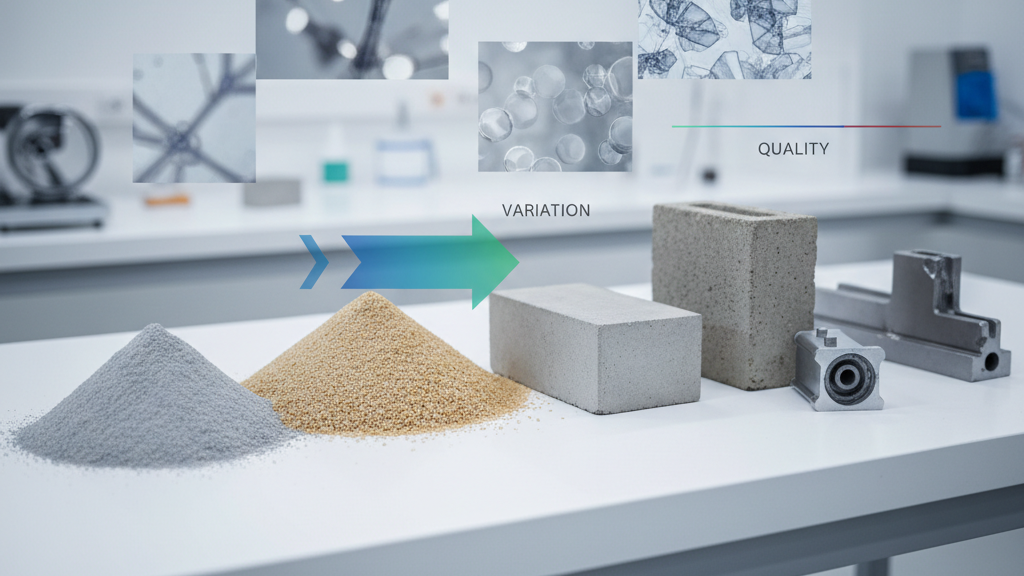
How Raw Material Variations Impact Manufacturing Quality: Fly Ash & Sand Analysis
Precision in masonry manufacturing depends heavily on consistent raw material inputs. Variations in fly ash or sand composition directly influence structural integrity, curing behaviour, and workability of blocks. This blog examines sources of variability, performance risks, and adaptation strategies for reliable production.
Common Sources of Raw Material Variability
In India, key factors driving inconsistency in fly ash blocks and related materials include:
- Coal source alterations – Thermal power plants using blended coals generate fly ash with divergent silica/alumina ratios.
- Sand gradation shifts – Riverbed mining yields inconsistent silt content and particle size distribution.
- Seasonal moisture ingress – Monsoon exposure changes sand bulking and fly ash flowability.
- Handling contamination – Stockpiling near construction debris risks aggregate impurity.
Fly Ash Source Variations: Key Considerations
Fly ash (per IS 3812 Part 1) must meet reactivity thresholds for stable block production. Critical variability factors:
- LOI (Loss on Ignition) – Unburnt carbon above 6% increases water demand and weakens bonding.
- SiO2+Al2O3+Fe2O3 – Below 70% content reduces pozzolanic activity.
- Particle fineness – 45µm residue exceeding 34% slows strength gain.
Note: 85% of Indian thermal plants produce Grade F fly ash. Verified test reports should accompany each consignment.
Effects of Sand Quality on Production Output
Sand (per IS 383 Zone II ideal) influences production stability in three areas:
- Workability – Coarse sand (>2.36mm) requires excess water, risking capillary voids.
- Drying shrinkage – High silt (>8%) increases cracks post-demoulding.
- Adhesive bonding – Irregular gradation prevents consistent thin-bed layer thickness.
Analysing the Impact on Final Product Quality
Unchecked variability manifests in finished blocks as:
- 15-20% compressive strength (IS 2185-3) fluctuation between batches.
- Surface friability from incomplete hydration due to LOI spikes.
- Dimensional instability (±3mm vs standard ±1.5mm).
Best Practices for Managing Material Variability
Proactive measures ensure consistent FlyAsh Block output:
- Pre-batch testing – Sieve analysis for sand, LOI/fineness checks for fly ash.
- Dedicated stockpiles – Separate storage by verified material source.
- Process water metering – Adjust automatically for sand moisture changes.
- Curing protocol adaptation – Extend steam curing if reactivity drops.
Strict control over raw materials directly correlates with compliance to IS 2185 Part 3 for masonry units. Factoring variability into production planning minimises rejection rates and maintains structural reliability.