

Introduction to Autoclaved Aerated Concrete (AAC) Blocks and Their Composition
Autoclaved Aerated Concrete (AAC) blocks are lightweight precast construction materials known for their thermal insulation and structural efficiency. Composed of quartz sand, calcined gypsum, lime, cement, water, and aluminium powder, AAC undergoes a chemical reaction during manufacturing that creates its characteristic porous structure. While Featherlite Buildcon manufactures FlyAsh Blocks (a distinct product), understanding AAC’s composition helps contextualise material comparisons.
The Role of Aluminium Powder in AAC Block Production
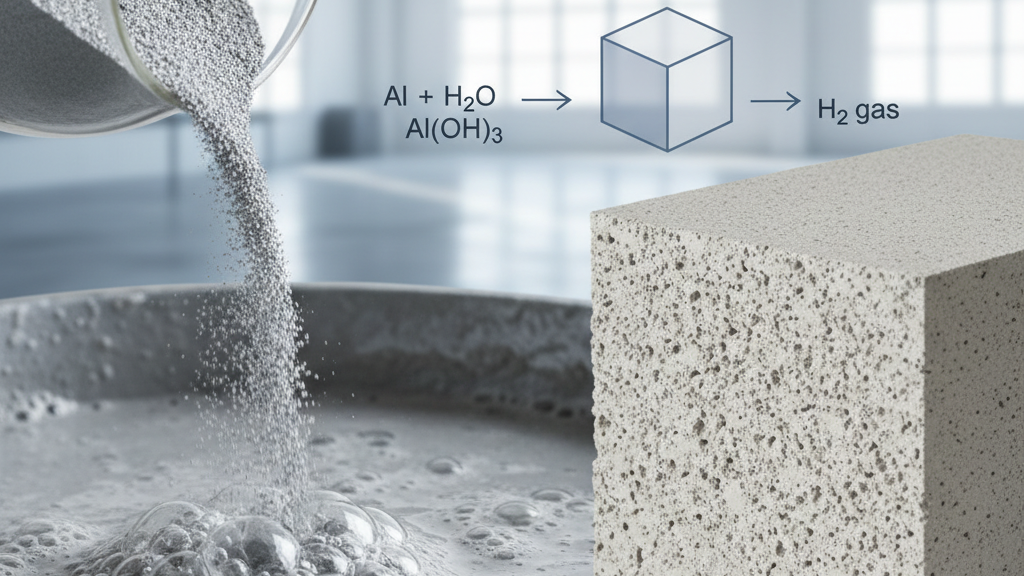
Aluminium powder acts as the primary foaming agent in AAC manufacturing, triggering a gas-forming reaction when mixed with lime and water. This reaction (hydrogen gas release) generates millions of microscopic air pockets, resulting in the material’s low density (400–800 kg/m³). Unlike traditional concrete, where aggregates determine porosity, AAC’s cellular structure stems from this controlled chemical process.
How Aluminium Powder Works as a Foaming Agent
The foaming mechanism follows a precise sequence:
- Aluminium (Al) reacts with calcium hydroxide (Ca(OH)2) from lime in an alkaline environment: 2Al + 3Ca(OH)2 + 6H2O → 3CaO·Al2O3·6H2O + 3H2↑
- Hydrogen gas (H2) forms bubbles, expanding the mixture by up to 3x its initial volume.
- The slurry sets before autoclaving, stabilising the porous matrix.
Fuel consumption during autoclaving reduces by ~40% compared to dense concrete due to AAC’s insulating voids (IS 2185-3:1984).
Benefits of Aluminium Additives in AAC Manufacturing
Controlled use of aluminium powder ensures:
- Uniform porosity: Even distribution of 1–3 mm diameter cells enhances compressive strength (3–5 N/mm² as per IS 2185).
- Weight reduction: AAC blocks weigh 1/3rd of conventional bricks, lowering dead loads on structures.
- Thermal efficiency: Air voids limit heat transfer (thermal conductivity: 0.16–0.22 W/mK).
- Workability: Softened green cake allows precise cutting before autoclaving.
Types of Aluminium Powder Used in AAC Production
Manufacturers select powders based on particle morphology and reactivity:
- Atomised powder: Spherical particles (20–50 µm) ensure predictable reaction kinetics.
- Flake powder: Higher surface area accelerates gas generation; requires stringent dosing control.
- Coated variants: Phosphoric acid-treated powders delay reactions for large-format blocks.
Dosages typically range from 0.2% to 0.5% of dry mix weight.
Quality Considerations for Aluminium Additives
Consistent AAC properties demand:
- Purity: ≥98% aluminium content (trace iron/silicon affects curing).
- Particle size distribution: Tight control via laser diffraction analysis (D50 = 30±5 µm ideal).
- Moisture resistance: Pre-oxidised powders prevent premature clumping.
BIS guidelines (IS 12813:1989) outline testing protocols for metallic additives in construction.
Environmental Impact and Sustainability
While aluminium production is energy-intensive, AAC’s lifecycle benefits offset this:
- 1 m³ AAC uses ~3 kg aluminium versus 150–300 kg cement in conventional masonry.
- Autoclaving with steam recycles 95% of process water.
- Post-industrial aluminium scrap often supplements virgin powder.
FlyAsh-containing formulations (like Featherlite’s FlyAsh Blocks) further reduce embodied carbon by utilising thermal plant waste.
Common FAQs About Aluminium in AAC Blocks
Does residual aluminium weaken blocks?
No – the reaction converts virtually all aluminium into stable hydrates (3CaO·Al2O3·6H2O) during curing.
Are AAC blocks fire-resistant despite aluminium?
Yes – autoclaved hydrates withstand 1,200°C for 4+ hours (NBC Group 1 rating). Hydrogen gas dissipates during manufacturing.
Can fly ash replace aluminium in AAC?
FlyAsh Blocks use distinct production methods; aluminium remains essential for aerated concrete’s gas-forming reaction.