

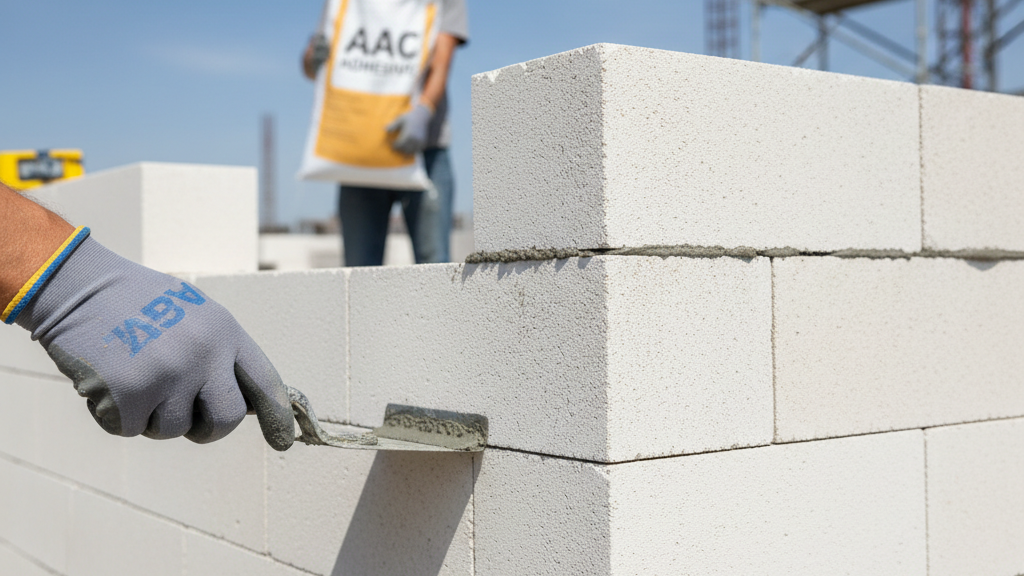
Understanding AAC Blocks and Their Benefits
Autoclaved aerated concrete (AAC) blocks are lightweight, precast building materials known for their thermal insulation, fire resistance, and structural efficiency. In India, AAC blocks are increasingly preferred for wall construction due to their:
- High compressive strength (3–5 N/mm² as per IS 2185 Part 3)
- Low thermal conductivity (0.16–0.21 W/mK)
- Reduced dead load on structures
However, their full potential is unlocked only when paired with compatible adhesives and thin-joint mortar systems.
The Role of Block Adhesives in AAC Construction
Block adhesives are polymer-modified cementitious products designed specifically for precision-engineered masonry units like AAC blocks. Unlike traditional sand-cement mortar, they offer:
- Thin joints (1–3 mm) that minimise thermal bridges
- Superior bond strength (≥ 0.5 N/mm² as per IS 1542)
- Reduced material wastage and faster application
Thin-bed adhesives can improve wall thermal performance by up to 20% compared to thick mortar joints.
Advantages of Using Thin-Joint Mortar with AAC Blocks
Thin-joint systems complement AAC blocks by:
- Maintaining dimensional accuracy of the masonry course
- Eliminating uneven shrinkage cracks common in thick joints
- Allowing construction speeds 3× faster than conventional methods
Their low water demand also prevents moisture retention in AAC blocks, a critical factor in humid Indian climates.
Preparing the Surface for Application
Proper surface preparation ensures optimal adhesive performance:
- Remove dust and loose particles with a stiff brush
- Check block surfaces for oil stains or curing compounds
- Lightly dampen AAC blocks in hot weather to prevent rapid moisture loss
Mixing and Applying Thin-Joint Mortar
Correct mixing and application techniques are crucial:
- Use clean potable water at 20–25°C
- Mix to a lump-free consistency (typically 5–6 parts powder to 1 part water)
- Apply with notched trowels (6×6 mm teeth for 3 mm joints)
- Maintain open time of 15–20 minutes (varies by product)
Comparing Block Adhesives vs. Traditional Mortar
| Parameter | Block Adhesives | Traditional Mortar |
|---|---|---|
| Joint thickness | 1–3 mm | 10–15 mm |
| Coverage | 25–30 kg/m³ | 60–70 kg/m³ |
| Curing time | 24 hours | 7–14 days |
Common Mistakes to Avoid When Using Thin-Joint Mortar
- Over-watering the mix, reducing bond strength
- Applying adhesive to damp or wet blocks
- Using expired or improperly stored products
- Ignoring ambient temperature effects on setting time
Tips for Maximising Efficiency with AAC Blocks
To optimise construction workflows:
- Plan cuts to minimise block wastage (standard sizes: 600×200×100–300 mm)
- Use battery-powered cutters for cleaner edges than manual saws
- Schedule plastering only after 72 hours of adhesive curing