
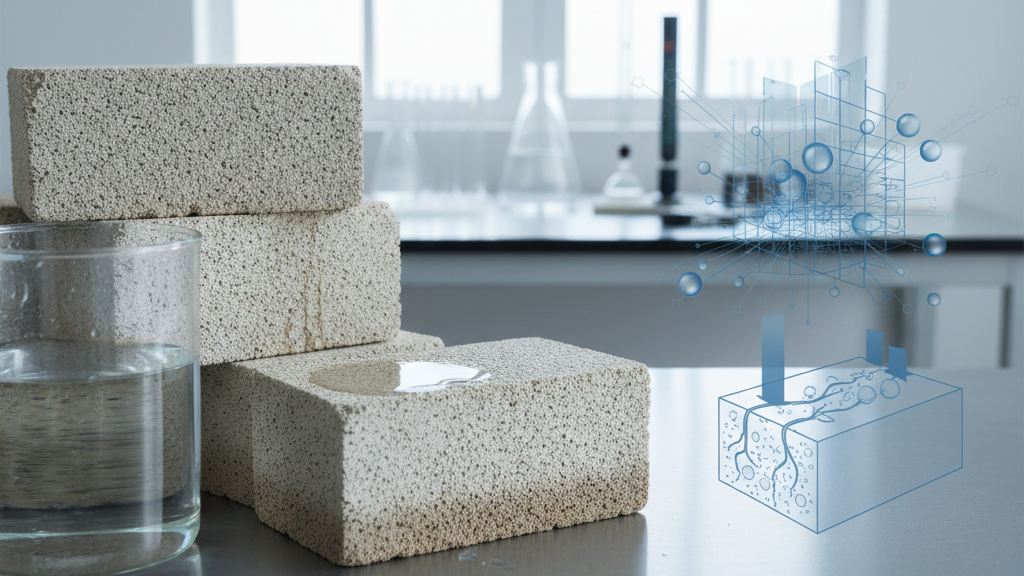
Understanding Moisture & Water Absorption Properties of Fly-Ash Blocks
Introduction to Fly-Ash Blocks
Fly-ash blocks are a sustainable alternative to traditional masonry units like clay bricks or concrete blocks. Made from fly ash, a by-product of coal combustion, these blocks offer improved thermal insulation and structural efficiency. One critical property governing their performance in construction is moisture and water absorption.
Why Moisture Absorption Matters in Construction
High water absorption in walling materials can lead to several long-term issues:
- Increased risk of efflorescence (salt deposits on surfaces)
- Reduced thermal insulation due to wetting
- Potential for mould and fungal growth in humid conditions
- Structural degradation from freeze-thaw cycles in colder regions
In India, where monsoons and high humidity are common, understanding moisture resistance is vital.
How Fly-Ash Blocks Absorb Water
Unlike dense clay bricks, fly-ash blocks have a porous microstructure due to their lightweight nature. Their absorption pattern is primarily through:
- Open surface pores drawing in liquid water during rains or spills
- Vapour absorption from humid air in poorly ventilated spaces
- Capillary action when placed in direct ground contact
As per IS 2185-3 (AAC block standards), absorption properties are classified based on drying shrinkage and wetting behaviour.
Factors Affecting Water Absorption in Fly-Ash Blocks
Key variables influencing absorption rates:
- Curing process: Properly cured blocks develop a denser surface layer
- Block density: Lower-density blocks (500-600 kg/m³) absorb more than high-density (700-800 kg/m³)
- Additives: Hydrophobic admixtures can reduce absorption by up to 40%
- Jointing method: Thin-bed adhesive joints decrease water ingress compared to thick mortar joints
Testing Methods for Moisture Absorption
Standard tests to assess absorption characteristics:
- IS 3495 (Part 2): 24-hour cold water immersion test
- ASTM C140: Measuring absorption after partial submersion
- Capillary absorption test: Tracking water rise in vertical samples
Typical absorption values for quality fly-ash blocks range between 10–18% by weight under IS testing protocols.
Comparing Fly-Ash Blocks to Traditional Materials
| Material | Water Absorption (% by weight) |
|---|---|
| Fly-ash blocks | 10–18% |
| Red clay bricks | 15–25% |
| Concrete blocks | 12–20% |
The closed-cell structure of fly-ash blocks often provides better humidity resistance than open-structured clay bricks.
Benefits of Low Water Absorption in Fly-Ash Blocks
- Improved durability in coastal and high-rainfall zones
- Better compatibility with thin-bed adhesives (reduced moisture transfer to the adhesive layer)
- Lower risk of plaster debonding due to differential shrinkage
- Stable thermal performance throughout seasonal humidity changes
Potential Challenges and Solutions
Challenge: Temporary absorption during monsoon storage
Solution: Use waterproof covers or elevated pallets
Challenge: Slow drying in thick walls
Solution: Allow extended curing time before plaster application
Challenge: Initial efflorescence in fresh masonry
Solution: Apply breathable acrylic-based waterproof coatings
Best Practices for Using Fly-Ash Blocks in Humid Conditions
- Elevate blocks above ground level during on-site storage
- Use vapour-permeable exterior finishes (like mineral-based plaster)
- Specify polymer-modified adhesives for high-humidity interiors
- Ensure at least 48 hours of drying post-rain exposure before jointing
Conclusion: The Future of Fly-Ash Blocks in Construction
With India’s focus on sustainable materials and need for climate-resilient construction, fly-ash blocks present a technically viable solution. Their optimised moisture absorption properties—when properly manufactured and installed—can deliver durable, energy-efficient walls in both humid and arid zones. Future developments in nano-coatings and densification processes may further enhance their water resistance.