
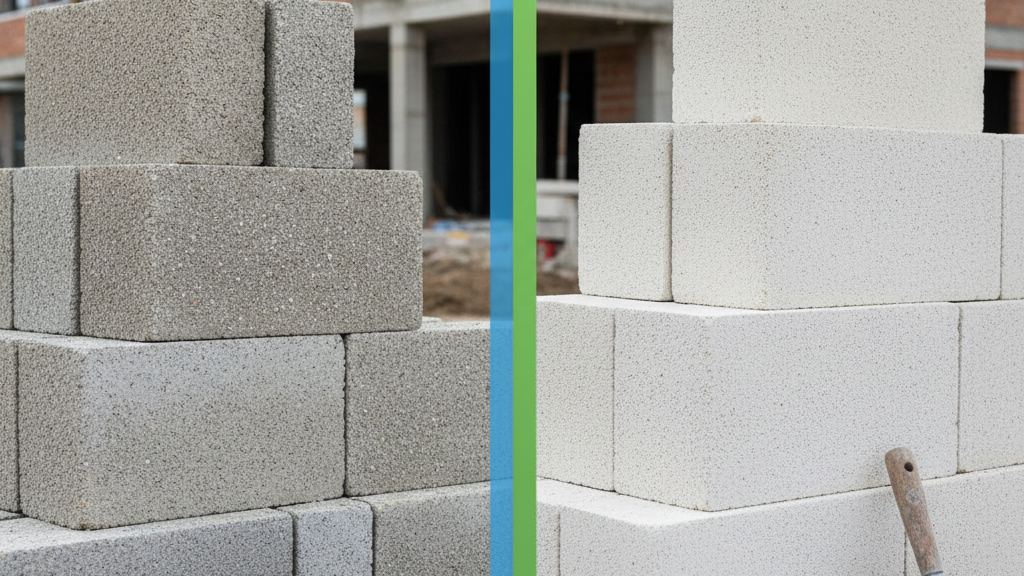
Introduction to Concrete and AAC Blocks
Concrete blocks and AAC (Autoclaved Aerated Concrete) blocks are widely used in Indian construction. Concrete blocks, made from cement, sand, and aggregates, have been traditional building materials for decades. AAC blocks, a lightweight alternative, consist of fly ash, cement, lime, and an aerating agent. Featherlite Buildcon specialises in FlyAsh Blocks—another sustainable choice for masonry work.
Key Differences Between Concrete and AAC Blocks
The main distinctions lie in composition, weight, and manufacturing:
- Material: Concrete blocks use cement, sand, and aggregates; AAC blocks include fly ash and aluminium powder.
- Density: Concrete blocks are heavier (1800–2200 kg/m³), whereas AAC blocks are lightweight (500–800 kg/m³).
- Thermal Insulation: AAC has better insulating properties due to air pockets.
Pros of Concrete Blocks
- High compressive strength: Suitable for load-bearing walls (IS 2185 Part 1).
- Durability: Resists weathering and moisture when properly cured.
- Cost-effective: Lower initial material cost than AAC in many regions.
Cons of Concrete Blocks
- Weight: Heavy, increasing transportation and labour costs.
- Poor insulation: Requires additional thermal barriers in extreme climates.
- Wastage: Cutting on-site generates debris.
Pros of AAC Blocks
- Lightweight: Reduces structural load and foundation costs.
- Thermal efficiency: Lower U-values (0.18–0.30 W/mK) minimise heat transfer.
- Workability: Easy to cut and shape without specialised tools.
Cons of AAC Blocks
- Lower compressive strength: May require reinforcement in high-rise construction.
- Brittleness: Handling cracks if mishandled during transit.
- Adhesive dependency: Poor mortar joints can compromise stability.
Which is Better? Concrete Blocks or AAC Blocks?
The choice depends on project needs:
- For load-bearing walls in high-stress environments, concrete blocks excel.
- For thermal efficiency and speed, AAC is preferable—similar to Featherlite’s FlyAsh Blocks.
- Hybrid approaches (e.g., concrete for foundations, AAC for partitions) are common.
Durability and Strength Analysis
Concrete blocks typically offer higher compressive strength (7–20 MPa) compared to AAC blocks (3.5–7 MPa per IS 2185 Part 3). However, AAC’s resistance to fire (up to 4 hours at 1200°C) and freeze-thaw cycles in temperate zones makes it durable in specific conditions.
Thermal and Sound Insulation Properties
AAC blocks provide superior insulation, with thermal conductivity around 0.21 W/mK versus concrete’s 1.25 W/mK. Sound reduction is also higher (45 dB for AAC vs. 35 dB for concrete walls of similar thickness).
Installation and Construction Process
Concrete blocks: Require thick mortar joints (10–15 mm) and manual labour for lifting.
AAC blocks: Use thin-bed adhesives (2–3 mm), reducing material waste and speeding up construction. Featherlite’s thin-bed adhesives further optimise FlyAsh Block installations.
Environmental Impact and Sustainability
AAC blocks use fly ash—a byproduct of coal plants—diverting waste from landfills. Concrete blocks rely on sand mining, which raises ecological concerns. Both materials are recyclable, though AAC’s lighter weight reduces transportation emissions.
Final Verdict: When to Use Each Block Type
- Choose concrete blocks for high-load structures, cost-sensitive projects, or where local AAC supply is limited.
- Opt for AAC or FlyAsh Blocks for thermal efficiency, seismic zones, or time-bound contracts requiring rapid construction.