
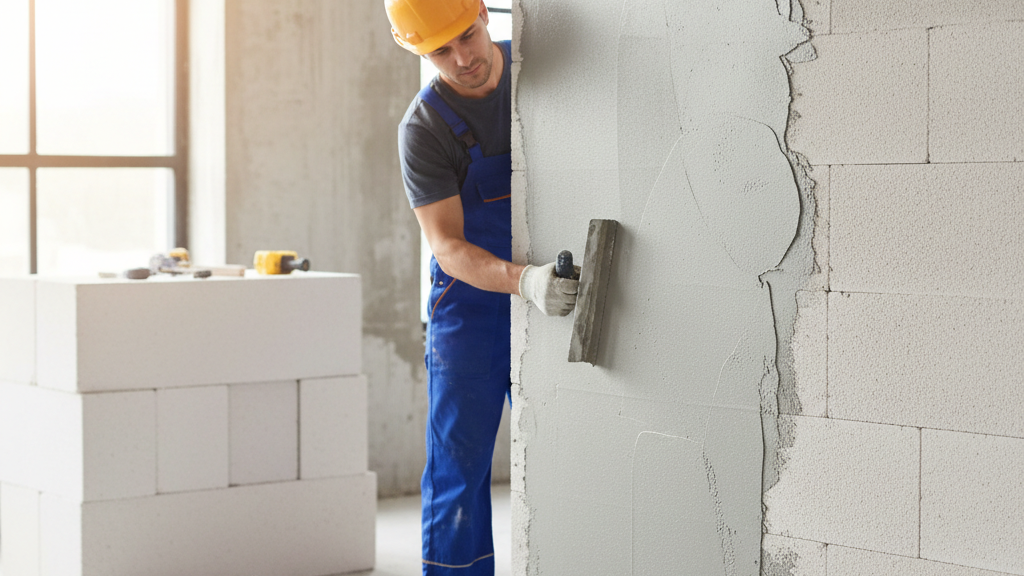
Understanding Readymix Plaster and AAC Walls
Readymix plaster is a factory-blended, polymer-modified material designed for consistent performance in masonry applications. When paired with AAC (Autoclaved Aerated Concrete) walls, it addresses unique substrate challenges—low density, high suction rates, and sensitivity to shrinkage cracks. Unlike conventional sand-cement plaster, readymix formulations contain additives to improve workability, adhesion, and moisture regulation—critical for AAC’s porous structure.
Key Benefits of Using Readymix Plaster on AAC Walls
Smooth and Crack-Free Finishes
Readymix plaster’s fine aggregates and shrinkage-resistant polymers minimise micro-cracks common in hand-mixed plasters. This is especially vital for AAC, which expands/contracts under thermal and moisture variations. The result: a uniform surface with reduced hairline cracks, even in India’s extreme temperature cycles.
Enhanced Durability and Weather Resistance
Precision-engineered mixtures include hydrophobic agents that reduce water ingress—a key weakness of untreated AAC. Tests under IS 2542 (for plaster durability) show readymix plasters withstand >50% fewer moisture-related defects versus traditional plasters after monsoon exposure.
Time and Cost Efficiency
- Faster application: Single-coat systems (8–12 mm thickness) achieve coverage 30–40% quicker than multi-layer sand-cement.
- Reduced wastage: Bagged mixes eliminate on-site proportioning errors, saving 15–20% material costs versus manual mixing.
Best Practices for Applying Readymix Plaster on AAC Walls
Surface Preparation Techniques
- Pre-wetting: Lightly spray AAC blocks 1–2 hours before plastering to control suction (avoid pooling water).
- Bonding agents: Apply a diluted PVA emulsion or acrylic primer on smooth AAC surfaces to improve adhesion.
- Grooving: For glossy AAC finishes, scrape surfaces with a wire brush to create mechanical keying.
Optimal Mixing and Application Methods
Note: Always follow manufacturer’s water-to-powder ratios—typically 0.22–0.25 by weight for AAC applications.
- Mix using a slow-speed drill (500–600 RPM) for 3–4 minutes until lump-free.
- Apply in upward sweeps with a steel trowel, maintaining 6–10 mm thickness per pass.
- Level within 20–30 minutes of application using a straight edge.
Curing and Drying Recommendations
AAC’s moisture retention demands cautious curing:
- First 48 hours: Mist-spray plaster twice daily—no direct water jets.
- Drying phase: Allow 7–10 days before paint application in humid climates (relative humidity >70%).
Common Mistakes to Avoid When Plastering AAC Walls
- Over-thickening mixes: Adding excess water weakens compressive strength and increases crack risk.
- Ignoring expansion joints: AAC movement requires plaster joints aligned with blockwork’s control joints.
- Using rigid tools: Hard steel trowels can tear aerated surfaces; opt for flexible finishing tools.
Choosing the Right Readymix Plaster for AAC Walls
Key selection criteria:
- Elastic modulus: Ideal range: 3–5 GPa (matches AAC’s low stiffness)
- Vapour permeability: ≤0.15 mg/(m·h·Pa) to balance breathability and water resistance
- Standards compliance: Verify IS codes (e.g., IS 2547 for gypsum-based plasters)
Technical datasheets should specify “AAC-compatible” or “low-density substrate” suitability.