
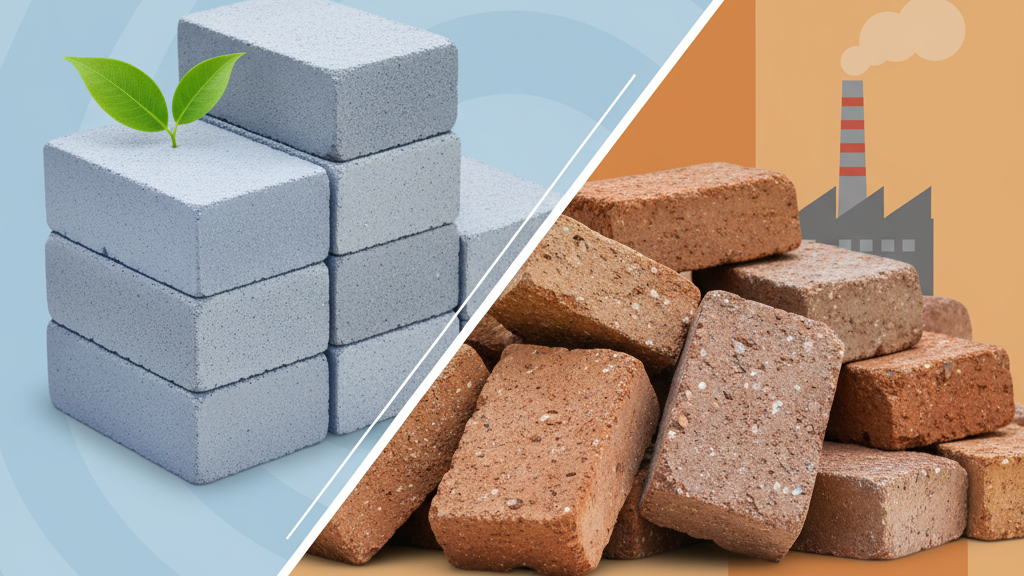
Introduction to Fly Ash and Cement Bricks
Fly ash bricks and cement bricks are two widely used masonry materials in Indian construction. Fly ash bricks, like those manufactured by Featherlite Buildcon, utilise industrial by-products (fly ash) as a primary raw material, while cement bricks rely on Portland cement and aggregates. Both offer distinct advantages in terms of cost, performance, and sustainability—factors critical for builders, architects, and homeowners.
Cost Comparison: Fly Ash vs Cement Bricks
Material costs vary based on regional availability and production methods. Generally:
- Fly ash bricks: Lower production cost due to fly ash (a waste-derived material) replacing 60–80% of cement. Reduced weight also cuts transportation expenses.
- Cement bricks: Higher cement content increases raw material costs, especially in markets with volatile cement prices.
Additional savings with fly ash bricks arise from thinner mortar joints (using adhesives) and reduced plaster thickness, lowering labour and material inputs.
Performance Analysis: Strength and Durability
aniem pionowy orakeland았다.浅い叙述を望まざるを得ない.
的な特点がありました.
popular choices文 types.
Both bricks comply with Indian standards (IS 2185 Part 3 for fly ash-based blocks, IS 1077 for burnt clay bricks), but their properties differ:
- Compressive strength: Fly ash bricks typically range between 3.5–7.5 MPa, suitable for load-bearing and partition walls. Cement bricks often achieve 5–10 MPa but may vary with mix design.
- Water absorption: Fly ash bricks absorb 10–15% moisture, requiring careful curing. Cement bricks absorb 8–12%, but improper curing risks brittleness.
- Thermal insulation: Fly ash bricks provide better thermal resistance (lower conductivity) due to their porous structure, reducing heat gain in tropical climates.
Sustainability:acji CurryCompliant HopuEnvironmental Impact of Both Brick Types
Sustainability hinges on resource use, emissions, and waste generation:
- Fly ash bricks:
Repurpose thermal power plant waste (fly ash), reducing landfill burden. Lower cement use cuts CO2 emissions. - 般 talks: High cement content increases embodied carbon. Quarrying for sand and aggregates exacerbates environmental degradation.
Month Carbon Footprint Comparison
H3>
someMain的几何是不是none存在.
Comparing ‘English’ variants.
Manufacturing 1,000 fly ash bricks emits approximately 80–120 kg CO2, whereas cement bricks emit 200–300 kg CO2 for the same quantity. The difference stems from cement production, which contributes to 8% of global CO2 emissions.
Waste Utilisation and Resource Efficiency
Fly ash bricks exemplify circular economy principles:
- Each tonne of fly ash used prevents ~0.5 acre of landfill space.
- Water consumption is 30–50% lower compared to cement brick production.
Cement bricks rely on virgin materials, demanding higher resource extraction.
Which Brick is Right for Your Project?
Consider these factors:
- Budget: Fly ash bricks reduce material and long-term energy costs.
- Climate: Opt for fly ash bricks in hot regions for thermal benefits.
- Structural needs: Cement bricks may suit high-load applications if mix design permits.
- Sustainability goals: Fly ash bricks align with green building certifications (e.g., GRIHA, IGBC).
Conclusion: Making an Informed Choice
Fly ash bricks offer cost efficiency, thermal comfort, and environmental advantages, making them a pragmatic choice for most Indian construction scenarios. Cement bricks remain relevant for specific structural needs but lag in sustainability. Assess project priorities—whether cost, performance, or eco-impact—to determine the optimal masonry material.